
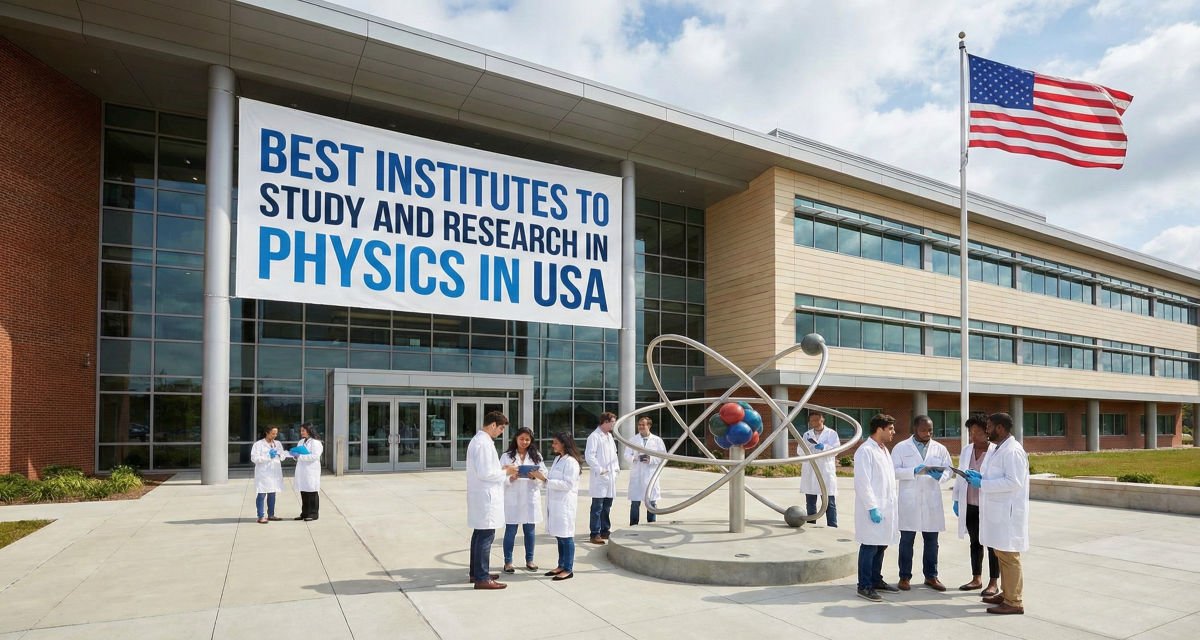
The United States is home to some of the world’s top physics research universities, known for pioneering discoveries in quantum mechanics, particle physics, astrophysics, condensed matter, and more. These institutions boast cutting-edge laboratories, internationally acclaimed faculty, and strong industry and government collaborations, offering students exceptional education and research opportunities from undergraduate to doctoral levels.
Leading Physics Institutes in USA (2025 Rankings)
- Massachusetts Institute of Technology (MIT): MIT tops the list with rigorous programs in classical and quantum mechanics, statistical physics, and advanced mathematics. Students benefit from collaborations with top research labs and a culture of innovation.
- Harvard University: Harvard excels in theoretical and experimental physics, with pioneering work in particle physics, cosmology, and biophysics supported by strong interdisciplinary programs.
- Stanford University: Known for research in condensed matter physics, astrophysics, and quantum computing, Stanford offers access to world-class facilities and Silicon Valley connections.
- California Institute of Technology (Caltech): Caltech is renowned for its focus on space science, experimental physics, and applied physics, with close ties to NASA’s Jet Propulsion Laboratory.
- University of California, Berkeley (UC Berkeley): Berkeley is a powerhouse in condensed matter, nuclear physics, and astrophysics, emphasizing collaborative research and serving as a hub for national laboratories.
- Princeton University: Princeton integrates theoretical physics and experimental innovation, with extensive work in quantum field theory, relativity, and cosmology.
- University of Chicago: Distinguished for research in high-energy physics, cosmology, and particle astrophysics, with notable faculty and Nobel laureates.
- Yale University: Yale offers strengths in condensed matter, atomic physics, and materials science, with interdisciplinary research and advanced instrumentation.
- University of Illinois Urbana-Champaign (UIUC): UIUC emphasizes condensed matter physics, optics, and materials physics with extensive laboratory and supercomputing resources.
- Johns Hopkins University: Known for applied physics, biophysics, and space science, Johns Hopkins combines research with medical and engineering collaborations.
Research Highlights and Facilities
- State-of-the-art experimental labs in quantum computing, high-energy physics, and nanotechnology.
- Collaborations with national labs such as Fermilab, SLAC, and Brookhaven.
- Advanced instrumentations including particle accelerators, telescopes, and ultra-cold atom setups.
- Interdisciplinary centers combining physics with materials science, chemistry, and biology.
Programs and Degrees
- Bachelor’s degrees in Physics or Applied Physics with research opportunities.
- Master’s programs focusing on advanced coursework and thesis research.
- PhD programs with extensive funding, teaching assistantships, and research fellowships.
- Postdoctoral programs linked to major research initiatives and academic mentorship.
Admission Requirements
- Strong academic background in mathematics and physics (GPA 3.7+ preferred).
- Research experience, laboratory work, or relevant internships.
- GRE general and physics subject tests (required by some programs).
- Recommendation letters from professors or research mentors.
- Personal statement outlining research interests and career goals.
Career Outcomes
- Academia: University faculty and principal investigators.
- Research labs: National laboratories, private sector research centers.
- Industry: Semiconductor technology, quantum computing, aerospace.
- Government and policy: Scientific advising and technology development.
The USA’s top physics institutes offer unmatched educational quality, research infrastructure, and career opportunities. From MIT’s rigorous programs to Caltech’s space science focus, students gain access to world-leading faculty and collaborative projects that push the frontiers of physics globally.
To contact us click Here .